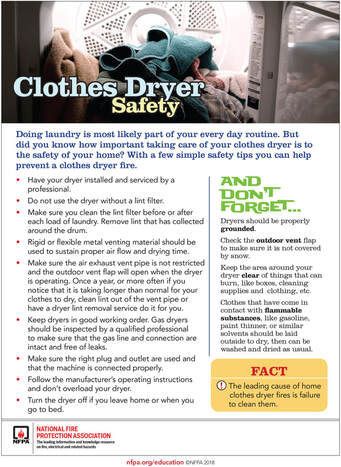
DRYER VENT SAFETY Did you know that clothes dryers are among the leading causes of fires in homes? Here are some important safety tips that could help prevent a dryer fire in your home. Clothes dryers evaporate the water from wet clothing by blowing hot air past them while they tumble inside a spinning drum. Heat is provided by an electrical heating element or gas burner. Some heavy garment loads can contain more than a gallon of water which, during the drying process, will become airborne water vapor and leave the dryer and home through an exhaust duct (more commonly known as a dryer vent). A vent that exhausts moist air to the home's exterior has several requirements:
A home inspection does not generally cite code, as we are not “code” inspectors. But for detailed information pertaining to this subject, the recommendations outlined below reflect International Residential Code (IRC) SECTION M1502 CLOTHES DRYER EXHAUST guidelines: M1502.5 Duct construction. Exhaust ducts shall be constructed of minimum 0.016-inch-thick (0.4 mm) rigid metal ducts, having smooth interior surfaces, with joints running in the direction of air flow. Exhaust ducts shall not be connected with sheet-metal screws or fastening means which extend more than 1/8” into the duct. This means that the flexible, ribbed vents used in the past should no longer be used. M1502.6 Duct length. The maximum developed length of a clothes dryer exhaust duct shall not exceed 35 feet from the dryer location to the wall or roof termination. The maximum length of the duct shall be reduced 2.5 feet for each 45-degree (0.8 rad) bend, and 5 feet for each 90-degree (1.6 rad) bend. The maximum length of the exhaust duct does not include the transition duct. This means that vents should also be as straight as possible and cannot be longer than 35 feet. Any 90-degree turn in the vent reduce this 35-foot number by 5 feet, since these turns restrict airflow. A couple of exceptions exist:
Exhaust ducts shall terminate on the outside of the building or shall be in accordance with the dryer manufacturer’s installation instructions. Exhaust ducts shall terminate not less than 3 feet in any direction from openings into buildings. Exhaust duct terminations shall be equipped with a backdraft damper. Screens shall not be installed at the duct termination. Often times we see dryer vents terminate in crawlspaces or attics where they deposit moisture. This can encourage the mold growth, wood decay, or other material problems. Sometimes they will terminate just beneath attic ventilators. This is a defective installation. They must terminate at the exterior and away from a door or window. Also, screens may be present at the duct termination and can accumulate lint and should be noted as improper. M1502.3 Duct size. The diameter of the exhaust duct shall be as required by the clothes dryer’s listing and the manufacturer’s installation instructions. Look for the exhaust duct size on the data plate. M1502.4 Transition ducts. Transition ducts shall not be concealed within construction. Flexible transition ducts used to connect the dryer to the exhaust duct system shall be limited to single lengths not to exceed 8 feet, and shall be listed and labeled in accordance with UL 2158A. Required support for lengthy ducts is covered by the following section: M1502.4.2 Duct installation. Exhaust ducts shall be supported at intervals not to exceed 12 feet and shall be secured in place. The insert end of the duct shall extend into the adjoining duct or fitting in the direction of airflow. Exhaust duct joints shall be sealed in accordance with Section M1601.4.1 and shall be mechanically fastened. Ducts shall not be joined with screws or similar fasteners that protrude more than 1/8-inch into the inside of the duct. Additionally, makeup air for the laundry room in an amount equal to the sum – in cubic feet per minute (CFM) – of the dryer vent fan, and of any laundry room fans, must be supplied when both fans are operating. Depending on the laundry room's size, this may approach 300 CFM. Makeup air would need to be supplied from some source. If the door is closed and there is no window, this may present a problem, including extended drying times and reduced dryer vent flow that can cause an excess accumulation of lint in the exhaust vent, which is a potential fire hazard. In general, an inspector may not know specific manufacturer’s recommendations or local applicable codes and may not be able to confirm the dryer vent's compliance to them, but will be able to point out major safety issues that should be corrected.
0 Comments
Your comment will be posted after it is approved.
Leave a Reply. |
Categories
All
Archives |